Milwaukee vs DeWalt Circular Saws: 2026 Contractor Test
Three weeks ago I was framing a pool house addition with a kid straight out of trade school, and he showed up with a DeWalt DCS573B he'd bought used off a buddy — no charger, no manual, just the bare saw and a prayer. I handed him one of my batteries so he could keep cutting joists while I ran my Milwaukee 2732-20 on the header beams. By 3pm we'd both burned through a full pack of 6.0Ah batteries between the two saws, and neither one had bogged down once in wet, pressure-treated 2x10s. That's when it hit me: these two saws aren't really competing on power anymore. They're competing on everything else.
I've been running cordless circular saws on framing crews and remodel jobs for close to 15 years now, and I've owned both of these specific models — not demo units, not one-week loaners, actual saws that have lived in my truck through two winters. The Milwaukee 2732-20 is the one I reach for first on framing day, but the DeWalt DCS573B earns its keep if you're already bought into the FlexVolt ecosystem and don't want to drop another $250 on tools alone. Here's the honest breakdown.
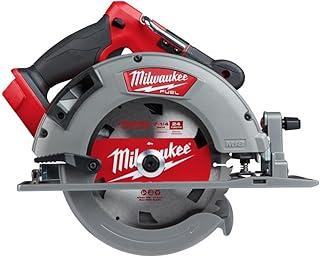
Milwaukee 2732-20 M18 FUEL 18V 7-1/4-Inch Cordless Circular Saw ($269.00)
Milwaukee 2732-20 M18 FUEL 18V 7-1/4-Inch Cordless Circular Saw (Tool Only)
Full-power cordless saw that rips through LVLs and wet framing lumber without bogging down, and it runs at full strength on any M18 battery you own.
$269.00
View on AmazonThe POWERSTATE brushless motor on this thing doesn't know the difference between dry pine and soaked PT lumber — I've cut hundreds of rafter tails on this saw and it's never stalled out on me, even ripping through double LVL headers. The blade-left orientation was an adjustment coming from years of corded sidewinders, but once it clicked I actually prefer it for following a line on long rips. Battery life is real too — I get close to a full day of framing on two 6.0Ah packs, and since it pulls full power off ANY M18 battery (not just the big ones), I can grab whatever pack is charged off my impact or grinder and keep moving.
The Bad: $269 for a bare tool stings if you're not already on the M18 platform — you're buying into batteries and a charger on top of that. The rafter hook feels like an afterthought and I've had it snap off catching on a stud. And if you've spent your whole career on a right-blade saw, give yourself a week to retrain your eye on the blade-left setup — I fought it at first.
DeWalt DCS573B FLEXVOLT ADVANTAGE 20V MAX 7-1/4-Inch Cordless Circular Saw ($245.99)
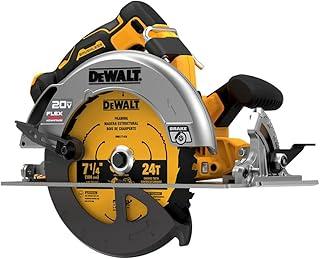
DEWALT DCS573B FLEXVOLT ADVANTAGE 20V MAX 7-1/4-Inch Cordless Circular Saw (Tool Only)
Solid, familiar sidewinder feel with a genuine power boost when you run it on a FlexVolt battery — and it's the cheaper tool-only buy of the two.
$245.99
View on AmazonThis is the saw I'd point a guy toward if he's already got a truck full of 20V DeWalt gear. The FlexVolt Advantage tech is legit — throw a FlexVolt battery on it and you genuinely get more torque and runtime than a standard 20V pack delivers, which matters when you're cutting engineered lumber all day. It's $23 cheaper tool-only than the Milwaukee, the bevel goes to 57 degrees instead of 53, and the standard blade-right orientation means zero learning curve if that's what you've always run. My buddy's used unit cut clean, straight lines all day on that pool house job with nothing but a beat-up 5.0Ah battery.
The Bad: Here's the catch — that power boost is only real with a FlexVolt battery. Slap a compact 20V pack on it and you're back to normal power, no advantage at all, which the name conveniently glosses over. The plastic base plate has some flex to it that the Milwaukee's doesn't, and after a year of jobsite abuse mine developed a slight warp that throws bevel cuts off a hair. The dust blower also does a mediocre job keeping the cut line visible on angled cuts.
| Feature | Milwaukee 2732-20 | DeWalt DCS573B |
|---|---|---|
| Blade Orientation | Blade-left (sightline for rips) | Blade-right (standard sidewinder) |
| Max Bevel Angle | 53°, dual field detents | 57°, dual-range bevel |
| Cuts Per Charge (comparable battery) | ~750 cuts on 5.0Ah | ~600 cuts on standard 20V pack |
| Weight (bare tool) | 8.4 lbs | 8.8 lbs |
| Full Power on Any Battery | Yes, consistent on all M18 packs | No, needs FlexVolt battery for advertised boost |
| Battery Platform Size | M18 (75+ tools) | 20V MAX / FlexVolt (300+ tools) |
| Tool-Only Price | $269.00 | $245.99 |
Real World Performance
Cutting Power & Accuracy: Both saws will chew through 2x framing lumber all day without drama, but the gap shows up in engineered lumber and wet stock. The Milwaukee's POWERSTATE motor holds RPM under load noticeably better than the DeWalt on a standard 20V battery — the DeWalt only closes that gap when you're running it on a FlexVolt pack. On straight rips, I trust the Milwaukee's blade-left sightline more once you're used to it; guys who've never run blade-left tend to track truer with the DeWalt's traditional layout right out of the box.
Battery Life & Runtime: The Milwaukee wins this outright because it doesn't have an asterisk attached. It pulls full performance from whatever M18 battery is in your bag, big or small. The DeWalt's "Advantage" is real, but it's conditional — you need to actually own and carry FlexVolt batteries, which cost more than standard 20V packs, to get the runtime and power DeWalt is advertising on the box.
Durability & Build Quality: Both have survived drops off sawhorses and getting buried in sawdust and debris in my truck bed. The Milwaukee's magnesium guard and shoe have held up a half-step better over two years of daily use than the DeWalt's composite base, which developed a slight warp on mine. Neither saw is fragile — this is a "which one degrades slower" comparison, not a "one of these breaks and one doesn't" comparison.
One more thing worth mentioning: if you're doing timber framing, deck ledger work, or anything where you want a rear-handle saw with more control on bevel cuts, Milwaukee's 2830-21HD kit is worth a look — it's a different animal (rear handle, kit with battery included, $579) but it's the saw I grab when I need more precision on tricky bevels. It's not a fair fight against either sidewinder here, just worth knowing it exists in the Milwaukee lineup.
Blade Selection & Maintenance
Neither saw is going to feel as sharp as its spec sheet promises if you're running the stock blade past its prime. The 24-tooth framing blades both saws ship with are fine for rough framing, but they dull fast in PT lumber loaded with preservative chemicals — I swap to a dedicated framing blade with a slightly higher tooth count (32T) once I'm doing anything that needs a cleaner edge, like exposed rafter tails or fascia cuts. Both saws take standard 7-1/4-inch arbor blades, so there's no brand lock-in on consumables, which matters more over five years of ownership than either saw's purchase price.
Dust management is where the two diverge a little. The Milwaukee's blower does a genuinely better job clearing the cut line on bevel cuts — DeWalt's is adequate on square cuts but loses the line fast once you tilt the shoe. Neither has a dust port worth hooking to a vac for serious dust collection; if you need that (finish work indoors, renovation with air quality concerns), you're looking at a track saw instead, not either of these.
On upkeep: both saws' shoes need occasional cleaning where resin and sawdust build up around the bevel adjustment mechanism, or you'll start losing bevel accuracy over time. I hit mine with compressed air and a shop rag every few weeks during a heavy framing stretch. Battery contacts are the other wear point on both — a contact cleaner pen once a season keeps power transfer consistent, especially if your batteries live in a truck bed through temperature swings.
One more consideration if you're outfitting a whole crew: buying identical saws across your team simplifies blade and battery logistics more than picking the objectively "better" saw model-by-model. A crew running mixed Milwaukee and DeWalt saws ends up carrying two sets of batteries and two blade inventories, which adds friction that outweighs small performance differences between the two.
Bottom Line
I keep both saws in rotation, but if I could only keep one in the truck, it's the Milwaukee 2732-20. The consistent full power across every M18 battery I own, the better runtime, and the durability edge are worth the extra $23 tool-only cost to me. That said, the DeWalt DCS573B is the smarter buy if you're already running a 20V/FlexVolt fleet — you're not going to go out and rebuy your whole battery collection just to switch brands for one saw, and with a FlexVolt battery on it, the performance gap mostly closes. Buy based on the batteries already in your bag, not just the saw in the box.