Leak detectors die in predictable ways: one gets drowned when a coil dumps condensate on it, another loses sensitivity so gradually the tech doesn't notice until pinhole leaks on R-410A systems start getting missed, and another just quits holding a charge. Knowing those failure modes is half of picking the right one.
2026 is also the year this gear stopped being interchangeable. With R-454B and R-32 now standard on most new residential splits and heat pumps, the detector in your bag has to actually respond to A2L blends, not just the legacy stuff. Heated diode sensors handle this fine in most cases, but sensitivity and false-alarm behavior vary a lot between units, and a detector that chirps constantly around a running condenser is worse than useless -- you stop trusting it, which defeats the point. We looked specifically at how each of these handles A2L refrigerants alongside the usual CFCs, HCFCs, and HFCs, because that's the question techs are asking most these days.
Here's how they stack up, from a budget pick that punches above its price to the detector built for a critical chiller job.
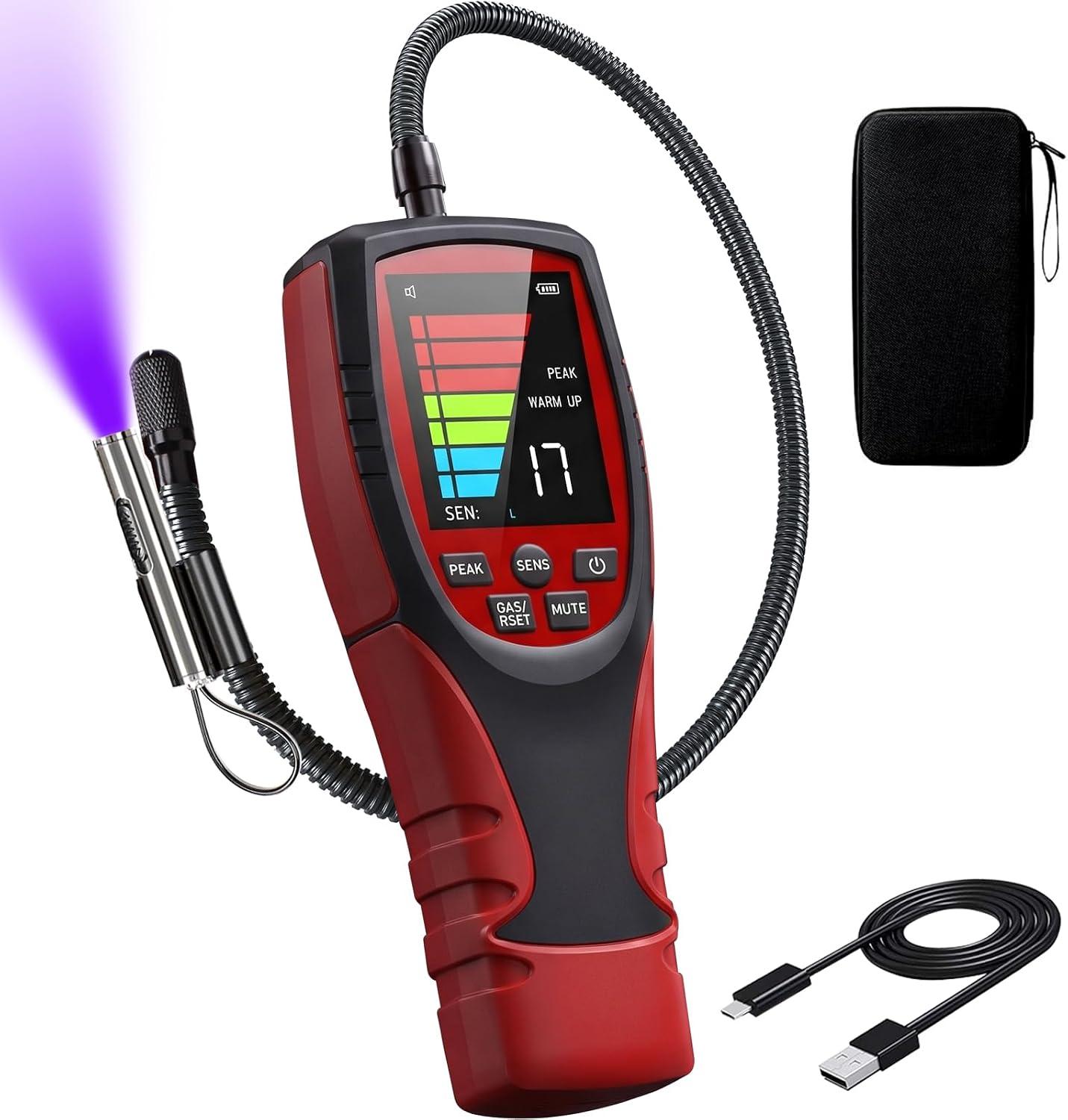
Refrigerant Leak Detector 3-in-1 A2L Professional Freon Sniffer for R454B
A genuinely capable budget detector that's built around A2L refrigerants from the ground up, not retrofitted to tolerate them.
$129.99
View on AmazonRefrigerant Leak Detector 3-in-1 A2L Professional Freon Sniffer for R454B
This is a great first detector for apprentices, and that's not a knock. For $130 you get a 16-inch flexible probe, three sensitivity levels down to a claimed 0.14 oz/yr, and a 2.8-inch TFT screen with a bar-graph display that makes it easy to walk a suspect braze joint and watch the reading climb instead of just listening for beep frequency to change. It's rated for R-32, R-454B, and R-290 alongside R-410A, R-134a, and R-22, so it's not a legacy-only tool wearing an A2L sticker -- the sensor was actually built around the newer blends.
Field use: the built-in UV/LED light at the probe tip is more useful than it sounds -- crawling into a dark air handler cabinet with a flashlight in one hand and a probe in the other is how you drop tools, and this skips that problem. The 3000mAh pack is sized to cover a full day of service calls without a midday charge, which wasn't a given on detectors twice this price a few years ago.
Main drawback: this is a sniffer, not a lab instrument, and it shows at the sensitivity edges. On a genuinely tiny leak -- the kind that's costing a system half an ounce a year -- it takes patience and multiple passes to get a confident hit, where a heated-diode Fieldpiece or Inficon would nail it faster. The plastic housing also isn't rated for the abuse a Pelican-cased unit can take; don't throw it in the bottom of a tool bag with wrenches.
Best for: techs building out a truck on a budget, or anyone who wants a dedicated A2L-capable unit without committing $350+ before they know how often they'll actually use it.
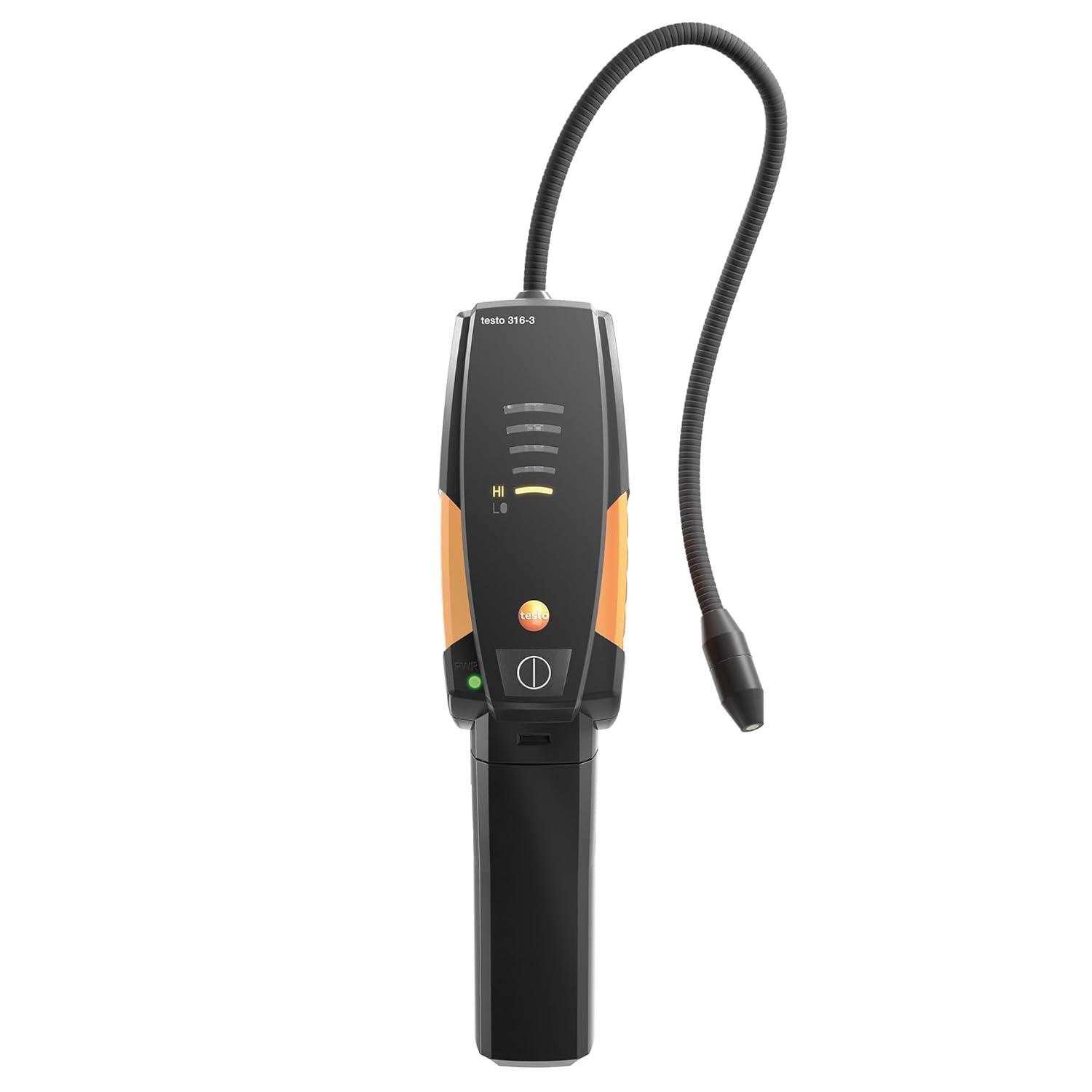
testo 316-3 Refrigerant Leak Detector
A2L-compliant out of the box with the automatic zeroing and build quality testo is known for -- the pick if R-454B and R-32 are becoming most of your call volume.
$334.41
View on Amazontesto 316-3 Refrigerant Leak Detector
testo built its reputation on manometers and thermal cameras that don't drift, and the 316-3 carries that same standard into leak detection. It's explicitly marketed as A2L compliant rather than "also works on A2L," which matters more than it sounds like it should -- it means the automatic zeroing and heated diode sensor were tuned with R-32 and R-454B's lower flammability thresholds in mind from the start, not patched in after the fact. Sensitivity is rated to 0.15 oz/yr, and it also covers R-404A, R-507, R-438A, and the rest of the legacy lineup, so you're not carrying two tools.
Field use: the automatic zeroing is the standout feature in practice. On a previously-contaminated area -- think a mechanical room where refrigerant has been vented before, or a rack of leaking case evaporators -- most detectors get confused by background concentration and either false-alarm constantly or go numb to it. The 316-3 re-zeros itself and keeps working, which is exactly what you need in a supermarket rack room where most detectors are useless.
Main drawback: one-button operation is great for simplicity but means less manual control over sensitivity than the Fieldpiece or Inficon units offer -- you're mostly trusting the auto-zero logic rather than dialing things in yourself. It's also a testo product, which means testo pricing on replacement sensors and accessories down the line.
Best for: techs whose route is shifting hard toward new-construction heat pumps and A2L systems, and who want one detector that treats that as the default case instead of an afterthought.
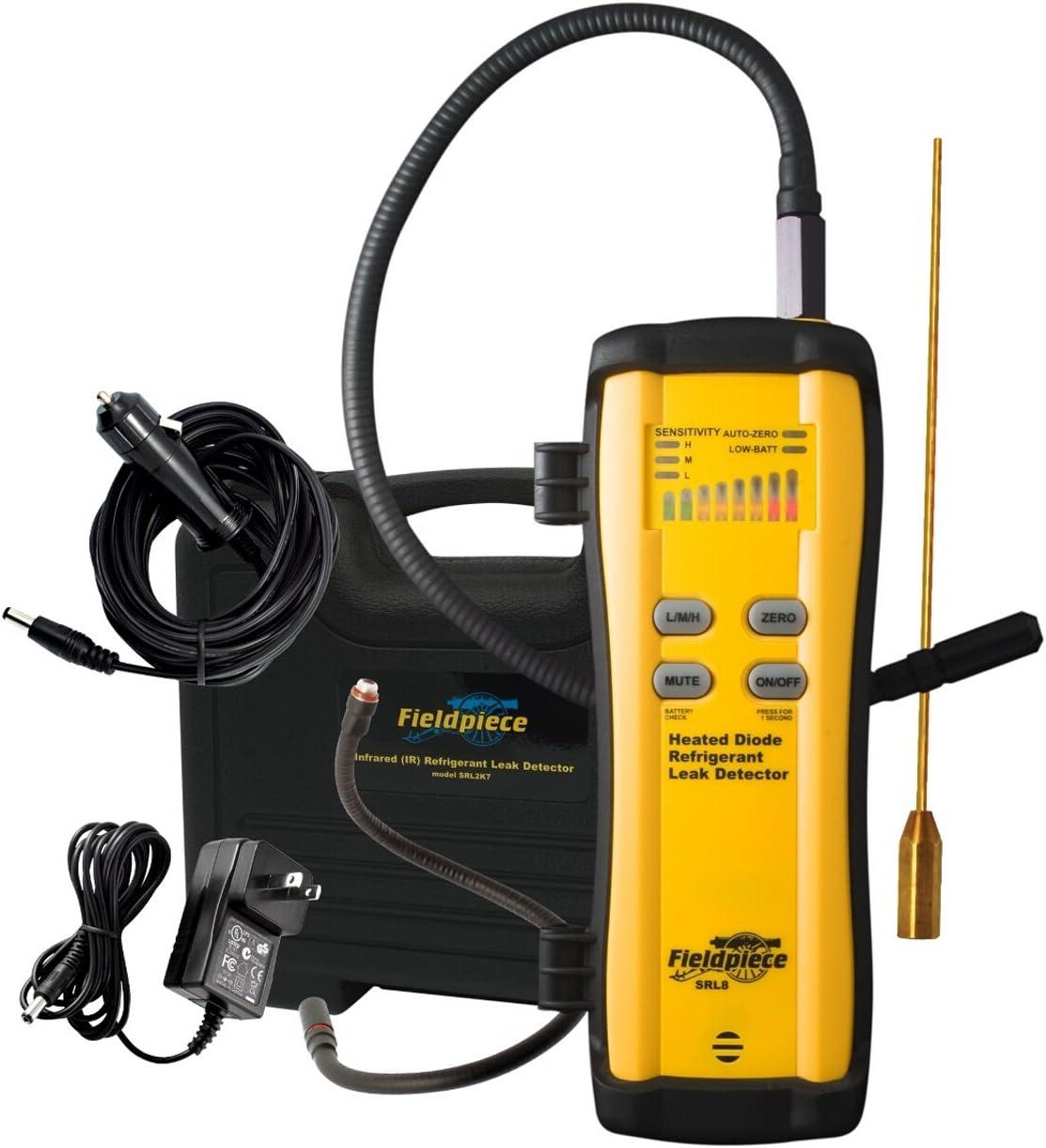
Fieldpiece Heated Diode Refrigerant Leak Detector - SRL8
The detector most working techs already own, for good reason -- fast warm-up, a real filter system, and a battery that survives a full shift.
$358.42
View on AmazonFieldpiece Heated Diode Refrigerant Leak Detector - SRL8
There's a reason this thing has over 300 reviews and sits on more service trucks than any other detector on this list -- it just does the job without drama. It's up and running in about 30 seconds, which matters more than it sounds like when you're paying for it in billable minutes; corona discharge and UV dye methods can leave you standing around for hours by comparison. The 15-hour rechargeable battery can stretch across two days of mixed service calls, and it charges off the wall or a vehicle adapter if you forget to plug it in overnight.
Field use: the filter system at the probe tip is the standout detail. It's designed to swell and cut off airflow to the sensor if it hits condensation or oil, which sounds minor until you've killed a sensor by sticking a probe into a wet coil without thinking about it. On cheaper detectors, that mistake means paying for a replacement sensor. The SRL8 auto-zeros every two seconds, then lets you lock in a manual zero once you're circling a suspected leak, which is the right workflow for actually pinpointing a spot rather than just confirming refrigerant is present somewhere nearby.
Main drawback: like every heated diode sensor, this one loses sensitivity over its service life and eventually needs a replacement sensor -- budget for that as a real cost of ownership, not a one-time purchase. It's also more sensitive to some refrigerants than others, so don't assume identical performance switching between an R-22 system in the morning and an R-454B heat pump in the afternoon without re-checking your technique.
Best for: the tech who wants one dependable detector for daily service work across a mixed bag of refrigerants, without needing to think too hard about which tool to grab.
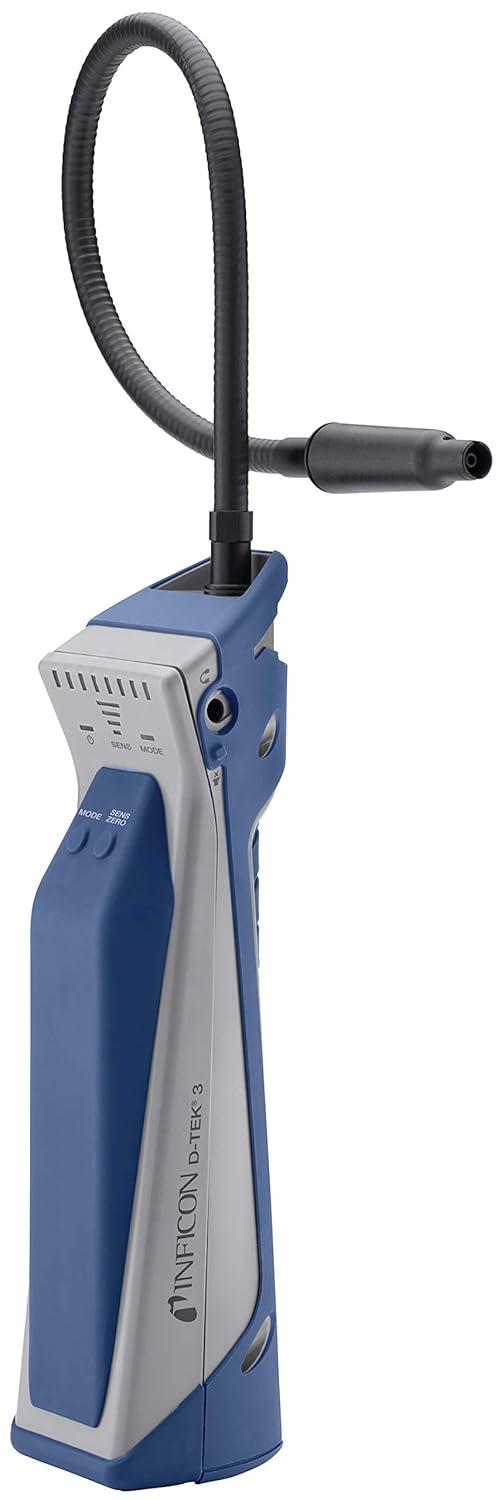
Inficon D-TEK 3 Refrigerant Leak Detector
Four sensitivity settings and a field-replaceable sensor system built for techs who need one detector to handle everything from A2L splits to legacy commercial rigs.
$581.99
View on AmazonInficon D-TEK 3 Refrigerant Leak Detector
Inficon's TEK-Mate is the budget name people know, but the D-TEK 3 is the one built for techs who don't want to compromise. It steps sensitivity across Low, Medium, High, and Super settings instead of a single fixed threshold, which is genuinely useful -- crank it down to Low walking into a mechanical room with background concentration, then push it to Super once you're circling a suspected fitting. It's rated to detect CFCs, HCFCs, HFCs, HFOs, and blends including A2Ls, so it's not a single-refrigerant specialist -- it's the generalist premium option.
Field use: the field-replaceable sensor and filter system is the real differentiator here. Sensors degrade on every heated-diode detector eventually, but Inficon designed the D-TEK 3 so swapping one takes a couple of minutes with no tools and no trip back to the shop, instead of shipping the whole unit off for service. The included rugged carrying case with the lithium-ion battery, charger, and spare filters is also the kind of kit you'd expect at this price -- nothing extra to buy just to get it field-ready.
Main drawback: this is a $580+ tool, and the improvement over the SRL8 for a tech doing routine residential service is marginal -- you're paying for sensitivity range and rebuild-ability more than day-to-day speed. If your work is mostly straightforward split-system service calls, you may not use the extra sensitivity settings often enough to justify the jump.
Best for: techs juggling a wide mix of refrigerants and system types -- commercial, residential, new A2L installs, and older R-22 holdouts all in the same week -- who want one detector that adapts rather than three specialized ones.
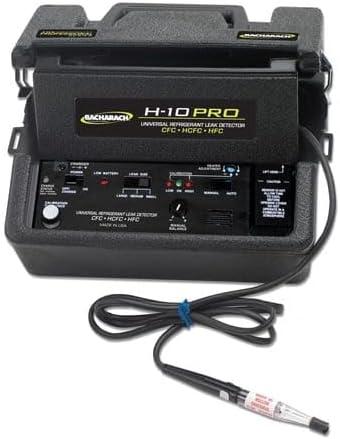
Bacharach 3015-8004 H-10 Pro Refrigerant Leak Detectors
The detector for critical leak testing where a missed leak isn't an inconvenience -- it's a failed inspection or a warranty claim.
$716.40
View on AmazonBacharach 3015-8004 H-10 Pro Refrigerant Leak Detectors
Bacharach doesn't build detectors for the average service call, and the H-10 Pro's price tag makes that clear before you even open the case. This is an instrument built for chiller work, critical refrigeration, and any job where "probably no leak" isn't an acceptable answer -- new equipment startups, warranty inspections, and systems where a missed slow leak means a callback on a six-figure rooftop unit rather than a $40 recharge.
Field use: what you're paying for is consistency at the sensitivity floor -- the ability to trust a "no leak detected" result on a system that absolutely cannot have one, not just a louder beep on an obvious leak. That's a different job than most detectors on this list are built for, and it shows in how deliberately it's designed: this isn't a tool you wave around quickly, it's one you use methodically, tracing joints and fittings the way a critical-leak inspection actually requires.
Main drawback: at over $700, this is real money for a tool that's overkill for routine residential and light commercial service -- if you're mostly doing split-system swaps and seasonal maintenance, you're paying for precision you won't use often enough to justify. It's also a specialist's tool in terms of workflow; techs used to a fast walk-and-beep detector will need to slow down to get the value out of it.
Best for: commercial and industrial techs, chiller specialists, and anyone whose job includes critical leak testing where a false "clean" reading has real consequences.
Recommendations by use case
- Tightest budget, still want real A2L support: the SIMBOW 3-in-1 A2L detector. It's not a lab instrument, but it's built around R-454B and R-32 rather than tolerating them, and $130 is a reasonable entry price for a dedicated unit.
- Route is shifting to mostly heat pumps and new A2L installs: the testo 316-3. Automatic zeroing in contaminated spaces is the feature that pays for itself fastest.
- Daily driver for mixed residential/light commercial service: the Fieldpiece SRL8. It's the detector most techs already trust, and there's a reason for that.
- Wide mix of refrigerants, system types, and job sizes: the Inficon D-TEK 3. The sensitivity range and field-replaceable sensor earn the higher price over time.
- Critical leak testing, chillers, warranty inspections: the Bacharach H-10 Pro. Overkill for routine service, exactly right when a missed leak is expensive.
Bottom line
If you only need one detector and your work is typical residential and light commercial service, the Fieldpiece SRL8 is still the safest recommendation -- fast, durable, and proven across hundreds of techs' trucks. If A2L refrigerants are becoming most of your call volume, don't just assume your current detector handles them well; the testo 316-3 and the SIMBOW A2L detector were both built around R-454B and R-32 specifically, and it shows in how they behave around those refrigerants versus units that just added a compatibility claim to an older sensor. And if a missed leak on your next job means more than a recharge -- a chiller, a warranty claim, a critical system -- the Bacharach H-10 Pro is the one tool on this list built for that level of certainty.
Whatever you land on, budget for sensor replacement as a real recurring cost, not a surprise. Every heated-diode detector on this list loses sensitivity over its service life, and the technicians who get burned by a missed leak are almost always the ones who kept running a sensor well past when it should've been swapped.